NIRVANA INSURANCE · LEAD PRODUCT DESIGNER · 2025 TO PRESENT
The routing data always existed.
The interface to make it visible didn't.
The routing data always existed.
The interface to make it visible didn't.
I designed the underwriting overview where every routing decision arrives with its reasoning, its sources, and a way to override it.
I designed the underwriting overview where every routing decision arrives with its reasoning, its sources, and a way to override it.


The Problem
Every commercial trucking submission lands in an underwriter's queue as a PDF, a spreadsheet or an email. Some are clean enough to quote in two minutes. Some are obviously outside appetite. Most sit in the middle and need real judgement.
Every commercial trucking submission lands in an underwriter's queue as a PDF, a spreadsheet or an email. Some are clean enough to quote in two minutes. Some are obviously outside appetite. Most sit in the middle and need real judgement.
In a traditional carrier all three arrive looking identical, so the underwriter triages by hand. A strong account and a hopeless one get the same effort. The easy work crowds out the hard work, and both get done worse than they could have been.
In a traditional carrier all three arrive looking identical, so the underwriter triages by hand. A strong account and a hopeless one get the same effort. The easy work crowds out the hard work, and both get done worse than they could have been.
The ROLE,AND HOW WE KNOW IT WORKED
I was the only designer on this, embedded with product, underwriting and engineering for three months. The brief started as a single question: how do we put the underwriter's attention where it matters most?
I was the only designer on this, embedded with product, underwriting and engineering for three months. The brief started as a single question: how do we put the underwriter's attention where it matters most?
The routing logic belonged to the underwriting team. My job was to make that logic legible, turning their decisioning framework into a surface underwriters could trust, verify and override. I took it from early concepts through several rounds of feedback with underwriters, until the behaviour felt right to the people using it every day.
The routing logic belonged to the underwriting team. My job was to make that logic legible, turning their decisioning framework into a surface underwriters could trust, verify and override. I took it from early concepts through several rounds of feedback with underwriters, until the behaviour felt right to the people using it every day.
Because the downside of getting this wrong is a bound policy that should never have been signed, it shipped behind a feature flag against a real holdout group. The doubling is measured against underwriters still working the old way.
Because the downside of getting this wrong is a bound policy that should never have been signed, it shipped behind a feature flag against a real holdout group. The doubling is measured against underwriters still working the old way.
The underwriter's morning starts here
The underwriter's morning starts here
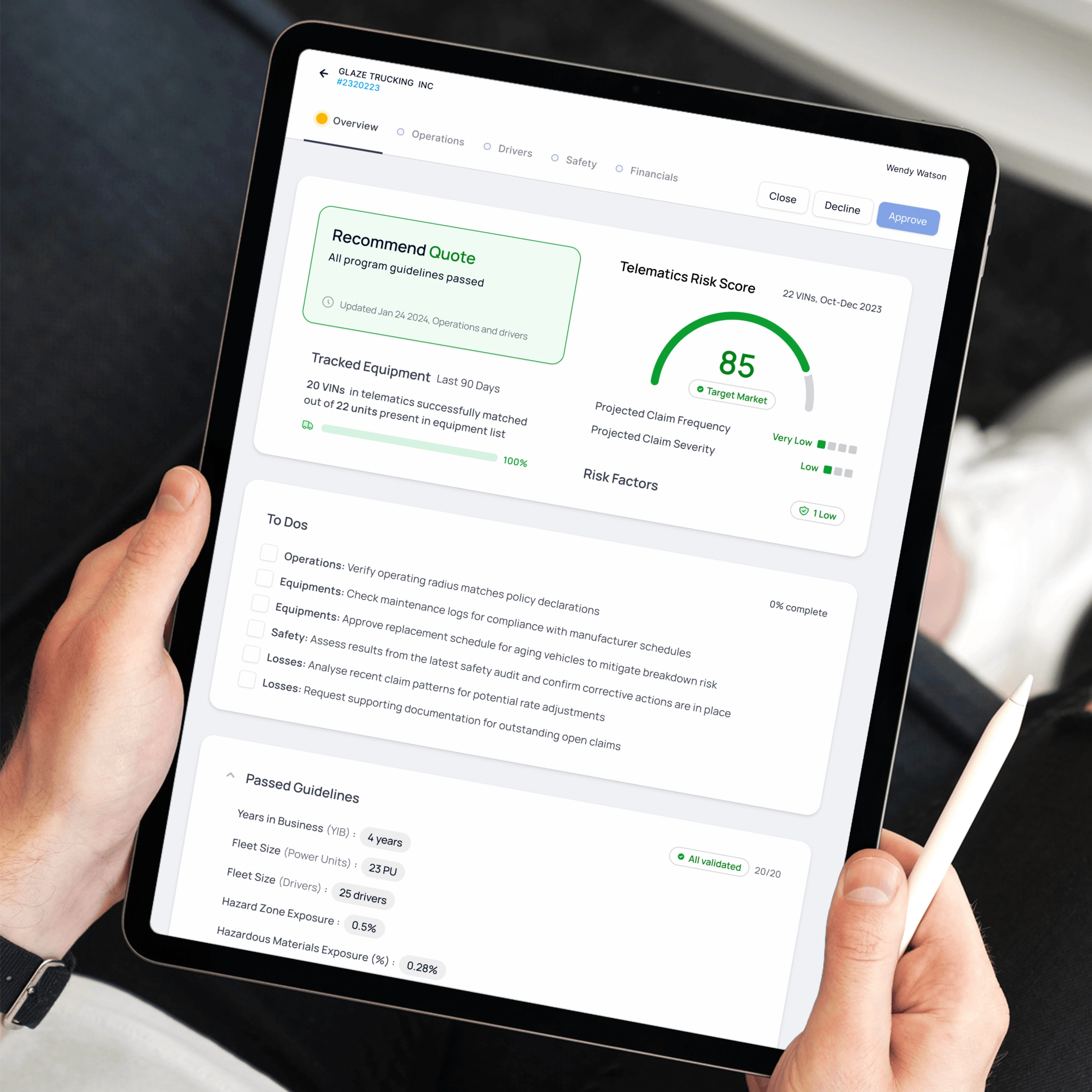
Every new submission has already been classified into one of four states.
Every new submission has already been classified into one of four states.


The Queue
Quote: clean accounts, all guidelines passed, ready to bind with one review.
Quote: clean accounts, all guidelines passed, ready to bind with one review.
Needs Review: the AI couldn't reach a confident recommendation. The underwriter is the tiebreaker.
Needs Review: the AI couldn't reach a confident recommendation. The underwriter is the tiebreaker.
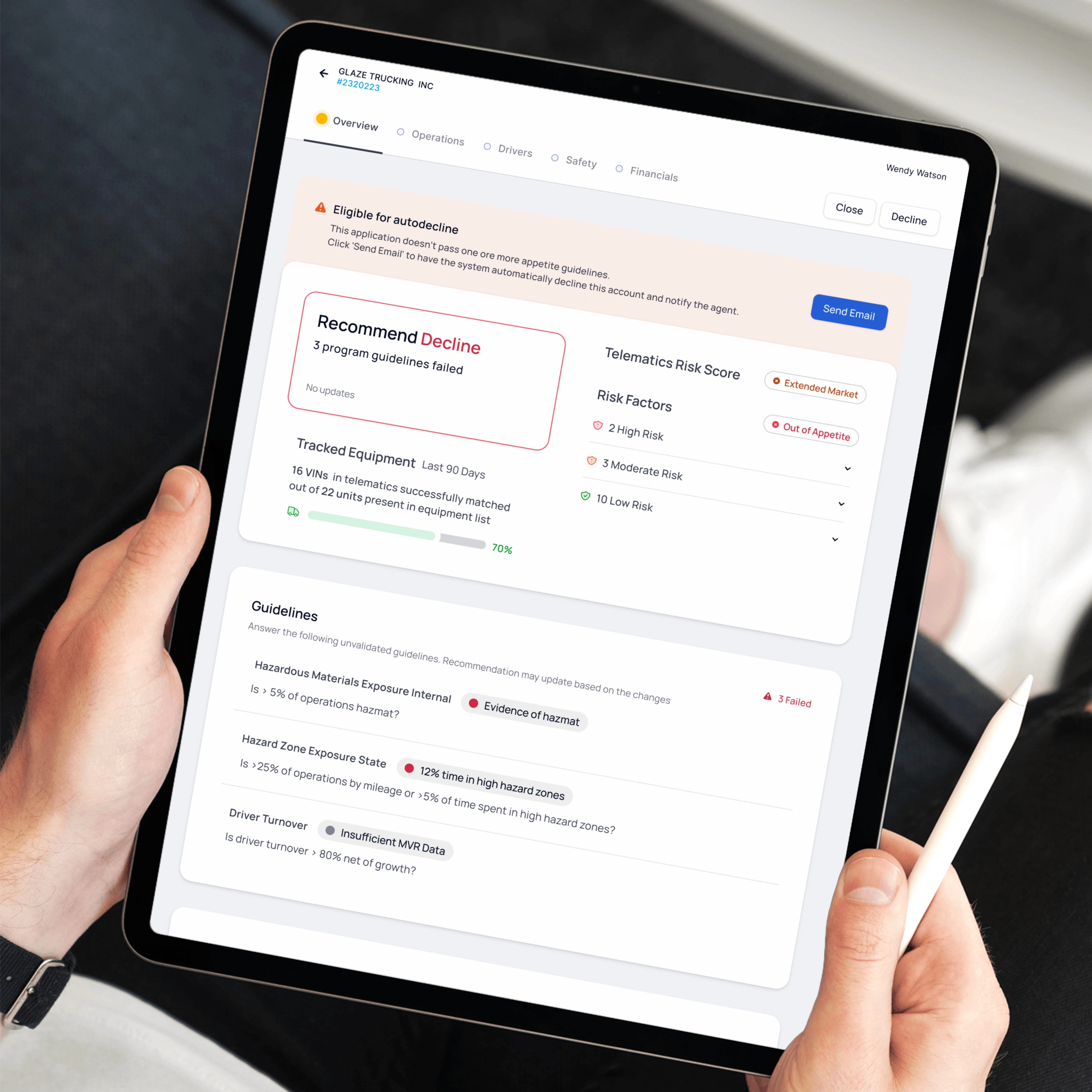
Auto-Decline: outside appetite. The notification to the broker is already drafted.
Auto-Decline: outside appetite. The notification to the broker is already drafted.
Data Pending: the AI is still gathering. The underwriter never sees these, which is itself a decision. An incomplete file sitting in a queue is noise, and noise was the thing we were removing.
Data Pending: the AI is still gathering. The underwriter never sees these, which is itself a decision. An incomplete file sitting in a queue is noise, and noise was the thing we were removing.
Each state is a routing decision the AI has already made, with its reasoning attached. The underwriter can verify it, override it, or accept it. The classification work is already done, and that is where the doubling comes from.
Each state is a routing decision the AI has already made, with its reasoning attached. The underwriter can verify it, override it, or accept it. The classification work is already done, and that is where the doubling comes from.
state 01 - quote
When the AI recommends Quote,
the underwriter's job is to check a conclusion rather than build one.
When the AI recommends Quote,
the underwriter's job is to check a conclusion rather than build one.
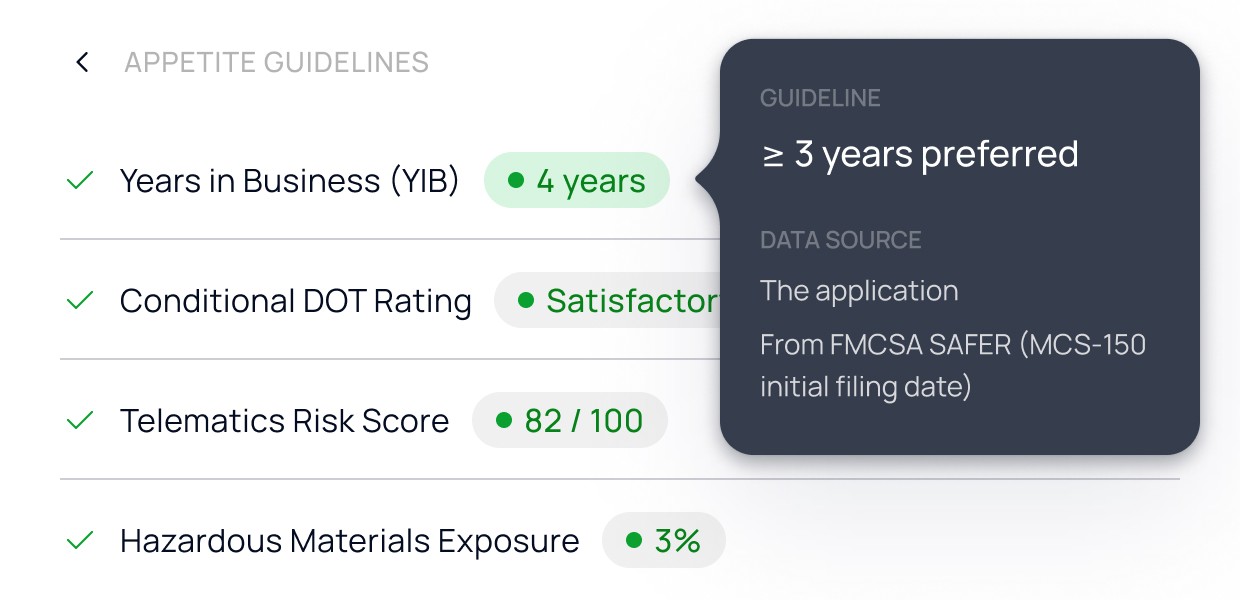
Three things become visible at once. The risk profile, where this account sits against the full submission pool. The risk score, how favourable it looks overall. And the appetite guidelines, how completely the AI was able to analyse what it was given.
Three things become visible at once. The risk profile, where this account sits against the full submission pool. The risk score, how favourable it looks overall. And the appetite guidelines, how completely the AI was able to analyse what it was given.
Everything the underwriter would have assembled manually is already on the surface, summarised and traceable. The recommendation is not "trust me, quote this". It is "here are the 16 guidelines, here is the score, and here is the data behind each one".
Everything the underwriter would have assembled manually is already on the surface, summarised and traceable. The recommendation is not "trust me, quote this". It is "here are the 16 guidelines, here is the score, and here is the data behind each one".
Every guideline carries its source, and the source is what tells an underwriter how much scrutiny to apply. A figure pulled from a regulatory record is not the same kind of fact as a figure typed in by a broker. Data cross-checked against FMCSA endorsements fails differently from data supplied by a telematics provider. An underwriter who knows the source knows what to question. They are not reading a number, they are reading a number with a history.
Every guideline carries its source, and the source is what tells an underwriter how much scrutiny to apply. A figure pulled from a regulatory record is not the same kind of fact as a figure typed in by a broker. Data cross-checked against FMCSA endorsements fails differently from data supplied by a telematics provider. An underwriter who knows the source knows what to question. They are not reading a number, they are reading a number with a history.
state 02 - Auto-Decline
When the AI recommends decline, the work shifts from writing the risk to communicating the decision.

Three things become visible at once. The risk profile, where this account sits against the full submission pool. The risk score, how favourable it looks overall. And the appetite guidelines, how completely the AI was able to analyse what it was given.
Three things become visible at once. The risk profile, where this account sits against the full submission pool. The risk score, how favourable it looks overall. And the appetite guidelines, how completely the AI was able to analyse what it was given.
Everything the underwriter would have assembled manually is already on the surface, summarised and traceable. The recommendation is not "trust me, quote this". It is "here are the 16 guidelines, here is the score, and here is the data behind each one".
Everything the underwriter would have assembled manually is already on the surface, summarised and traceable. The recommendation is not "trust me, quote this". It is "here are the 16 guidelines, here is the score, and here is the data behind each one".
Every guideline carries its source, and the source is what tells an underwriter how much scrutiny to apply. A figure pulled from a regulatory record is not the same kind of fact as a figure typed in by a broker. Data cross-checked against FMCSA endorsements fails differently from data supplied by a telematics provider. An underwriter who knows the source knows what to question. They are not reading a number, they are reading a number with a history.
Every guideline carries its source, and the source is what tells an underwriter how much scrutiny to apply. A figure pulled from a regulatory record is not the same kind of fact as a figure typed in by a broker. Data cross-checked against FMCSA endorsements fails differently from data supplied by a telematics provider. An underwriter who knows the source knows what to question. They are not reading a number, they are reading a number with a history.
state 03 - NEEDS REVIEW
When the AI can't reach a confident answer,
the surface has to hand over the smallest possible piece of work.
When the AI can't reach a confident answer,
the surface has to hand over the smallest possible piece of work.
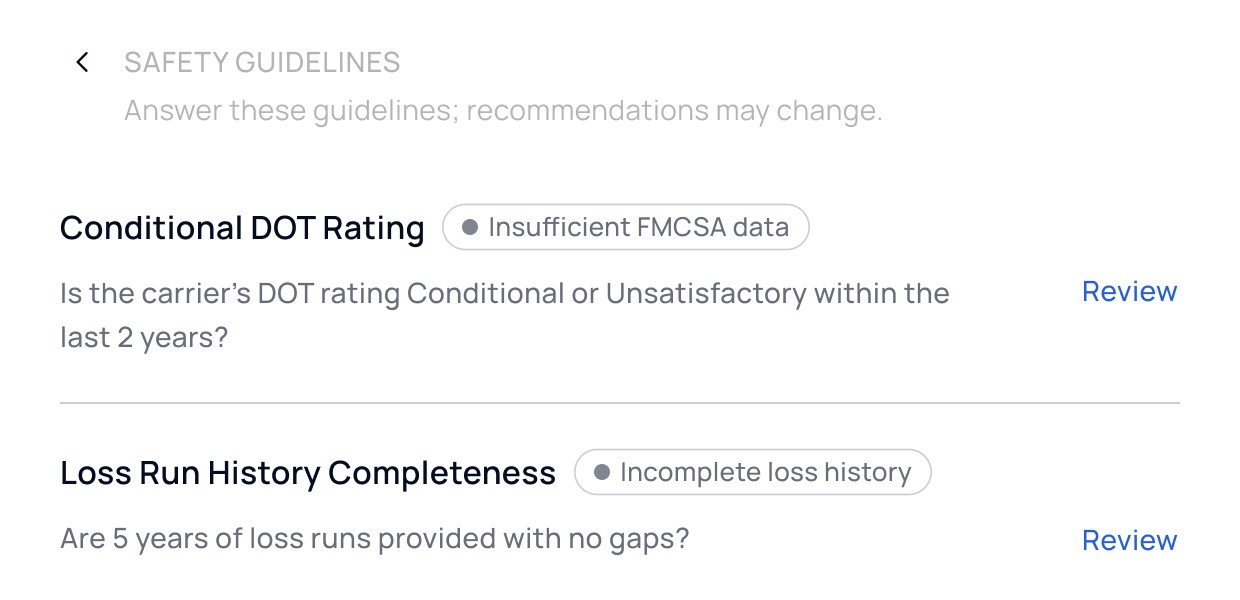
It does two things at once. It says exactly what is unresolved, and it makes resolving it small. The panel surfaces only the guidelines the AI could not validate. The underwriter clicks Review, answers that specific question, and the recommendation regenerates.
It does two things at once. It says exactly what is unresolved, and it makes resolving it small. The panel surfaces only the guidelines the AI could not validate. The underwriter clicks Review, answers that specific question, and the recommendation regenerates.
Seventy per cent of the submission is already validated. The surface names the remaining thirty. The underwriter's time goes to the unresolved part instead of the whole file.
Seventy per cent of the submission is already validated. The surface names the remaining thirty. The underwriter's time goes to the unresolved part instead of the whole file.
2x applications reviewed, same underwriter bandwidth.
The classification work was already done, so the underwriter's time went to the accounts that actually needed judgement.

" The hard part was never the interface. It was working out where the AI's judgement should stop and the underwriter's should start"
WHAT I GOT WRONG
The biggest contention wasn't whether to show the source behind each recommendation. It was how much room to give it.
The biggest contention wasn't whether to show the source behind each recommendation. It was how much room to give it.
In the first version I made the source a tooltip. Hover to see where the AI got each value. The reasoning was that most underwriters wouldn't drill in on most decisions, so the surface should stay clean for the ones who didn't.
In the first version I made the source a tooltip. Hover to see where the AI got each value. The reasoning was that most underwriters wouldn't drill in on most decisions, so the surface should stay clean for the ones who didn't.
We were wrong. Underwriters drilled in constantly, and the tooltip made it feel as though the system was withholding something.
We were wrong. Underwriters drilled in constantly, and the tooltip made it feel as though the system was withholding something.
The redesign made source attribution flexible rather than fixed. On declines it moved into the foreground. On quotes it stayed a step back, and the underwriter could pull either into focus depending on what they were investigating.
The redesign made source attribution flexible rather than fixed. On declines it moved into the foreground. On quotes it stayed a step back, and the underwriter could pull either into focus depending on what they were investigating.
Real estate has to flex with where the user is on the verification spectrum.
Real estate has to flex with where the user is on the verification spectrum.
WHAT THIS TEACHES ABOUT AI PRODUCTS
WHAT THIS TEACHES ABOUT AI PRODUCTS
Underwriters didn't want a binary quote or don't-quote. They thought in degrees, and they wouldn't accept a recommendation they couldn't interrogate. A confident answer with no way to check it reads as a system hiding something, and a system that seems to be hiding something gets ignored rather than argued with.
Underwriters didn't want a binary quote or don't-quote. They thought in degrees, and they wouldn't accept a recommendation they couldn't interrogate. A confident answer with no way to check it reads as a system hiding something, and a system that seems to be hiding something gets ignored rather than argued with.
So none of the work was visual. A queue with four states, a scorecard with sixteen guidelines, a tooltip showing where a number came from. The work was in the calibration: how the AI decides which state a submission belongs in, how visible the source should be, how easily it can be overridden, and what gets shown when the AI isn't confident.
So none of the work was visual. A queue with four states, a scorecard with sixteen guidelines, a tooltip showing where a number came from. The work was in the calibration: how the AI decides which state a submission belongs in, how visible the source should be, how easily it can be overridden, and what gets shown when the AI isn't confident.
Getting that wrong doesn't produce a slow product. It produces a bound policy that should never have been signed.
Getting that wrong doesn't produce a slow product. It produces a bound policy that should never have been signed.
The interface is simple. The consequences are not.
The interface is simple. The consequences are not.
back to home
TELL ME WHICH SURFACE NEEDS A DESIGNER.
UK-based, full working rights.
I write short notes on the design I notice off-screen.

READ NOTES

