Concept project · 2026 · 5 minute read
A broker's inbox is a compliance problem dressed as an admin task
A concept for an AI assistant that lives inside a broker's email, and a study of why intake is a verification problem, not an admin one.
ABOUT THIS PROJECT
This is a self-initiated concept project. I wanted to work through a problem that rarely gets a tool built for it: the commercial insurance broker's intake work, which sits between the broker's inbox and the carrier's system of record.
I designed the full product surface as an exploration. How an AI would communicate its progress during intake, how it would present conflicts, how it would draft the broker's first message back to the customer. Nothing here shipped. The point was to think through how an AI intake assistant would have to behave to be trusted inside a regulated workflow, and then design the interface that behaviour implies.
THE PROBLEM
A commercial insurance broker's day starts in their inbox. Customer emails arrive with attachments, fleet inventories, driver rosters, loss histories. The broker's job is to turn each one into a structured submission a carrier can quote.
In a traditional brokerage this is hours of manual work per submission. Open the email. Parse the spreadsheets. Cross check the driver licenses against the regulatory record. Format the data into the carrier's required schema. Write back to the customer to chase the missing pieces.
The broker spends most of their day on intake, not on selling. That is the design problem.
THE INTAKE
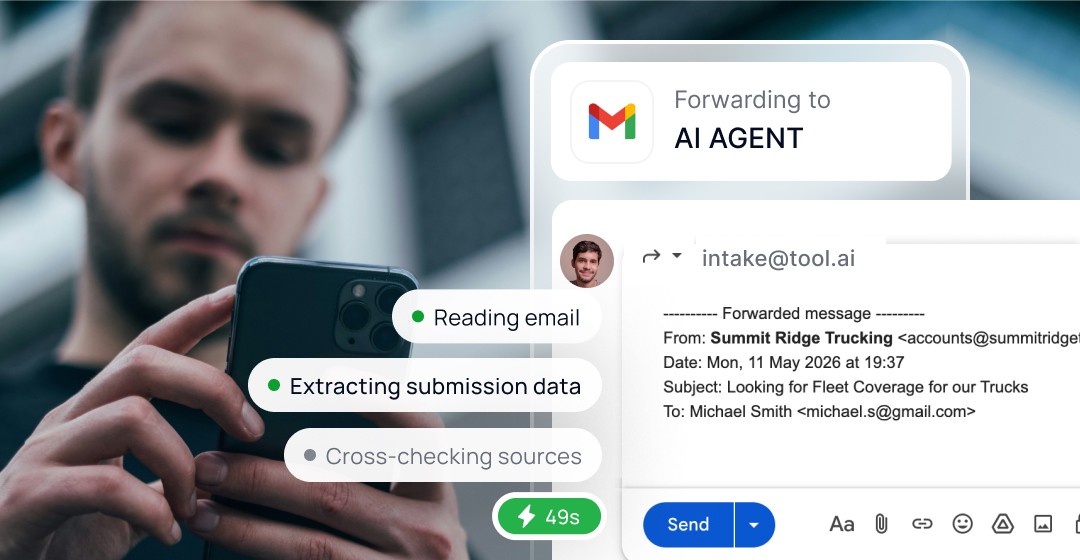
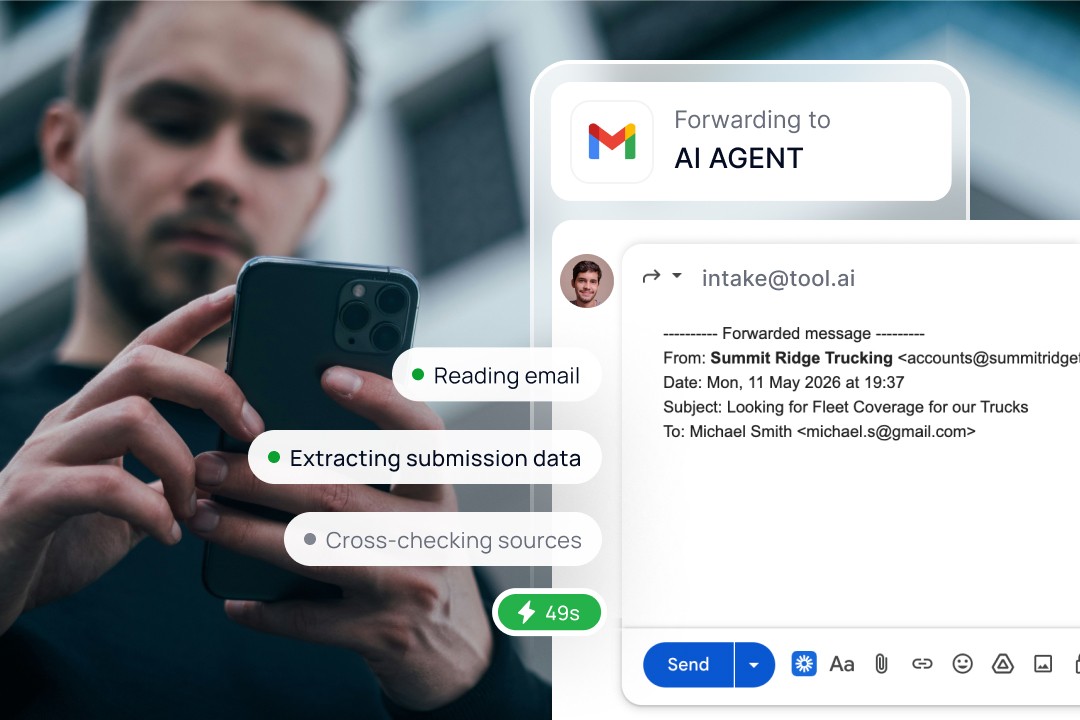
The workflow starts where the broker already lives. A customer sends them an enquiry. The broker forwards the email to intake@tool.ai and the AI starts working.
Three things happen: the AI reads the email body, extracts the structured data from the spreadsheets, and cross-checks the entries against the regulatory record.
The broker does not open a tool, does not log in, does not see a dashboard. They forward an email and the work happens in the background.
The best AI tool for a broker does not ask them to change how they work. It works inside the workflow they already have.
THE ASSESSMENT
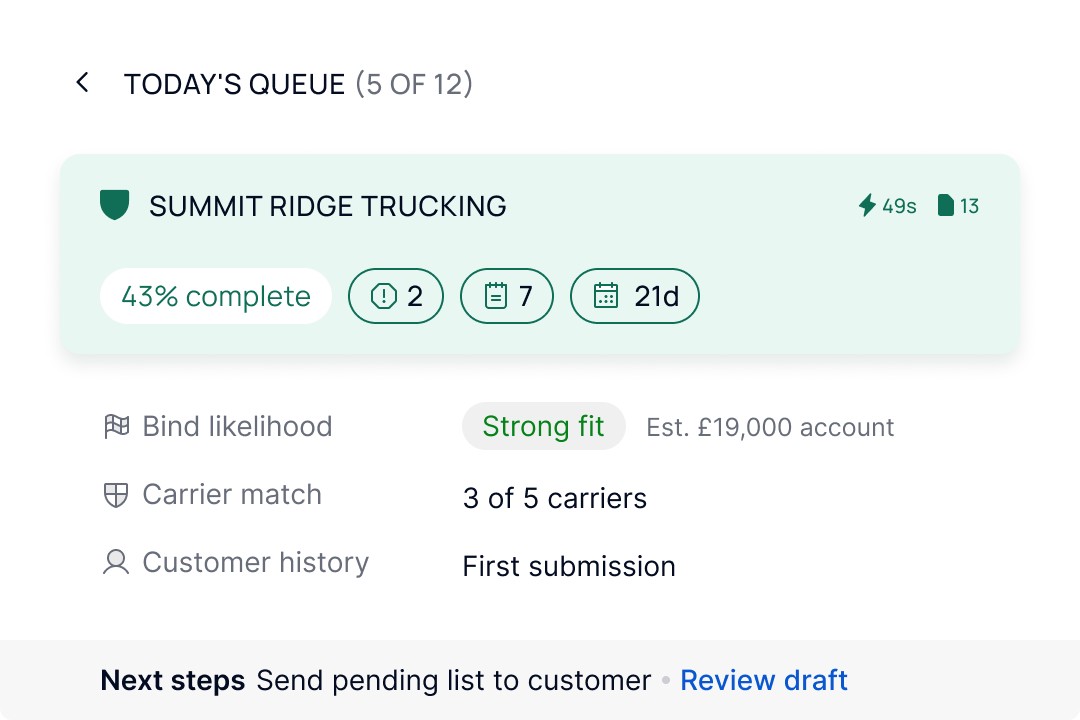
In one pass, the AI returns a structured assessment for every submission in the queue.
The first thing the broker sees is where each submission stands. How complete it is. How many conflicts need resolving. How many items need clarifying. How many days remain until the policy effective date. Not a vague "incomplete" label, a precise picture of exactly how much work is left and how much time there is to do it.
The second thing is an account read. Bind likelihood. Estimated account value. How many carriers in appetite. Whether this customer has submitted before. The broker does not have to open a single file to know which accounts are worth prioritising. The AI has already sized up the new business, in the same language a broker uses internally.
The third thing is a next step. Because every commercial trucking submission moves through the same intake stages, the AI knows which action will have the most impact on moving each one forward. The broker does not have to decide where to start. That call has already been made.
All of this, across every account in the queue, before the broker has opened a single email. The assessment is not a report on what the system processed overnight. It is the broker's morning brief, built so that the first few minutes of their day are spent on decisions, not on orientation.
THE DEEP DIVE
A commercial trucking submission is not a single document. It is a collection of sections: operations, equipment, drivers, financials, losses; each one a different lens on the same risk. A broker reviewing a submission has to ensure every section is complete, consistent, and strong enough to survive underwriter scrutiny. The AI works through each section the same way a senior broker would, knowing what carriers look for and what triggers rejection.
Take drivers as an example.
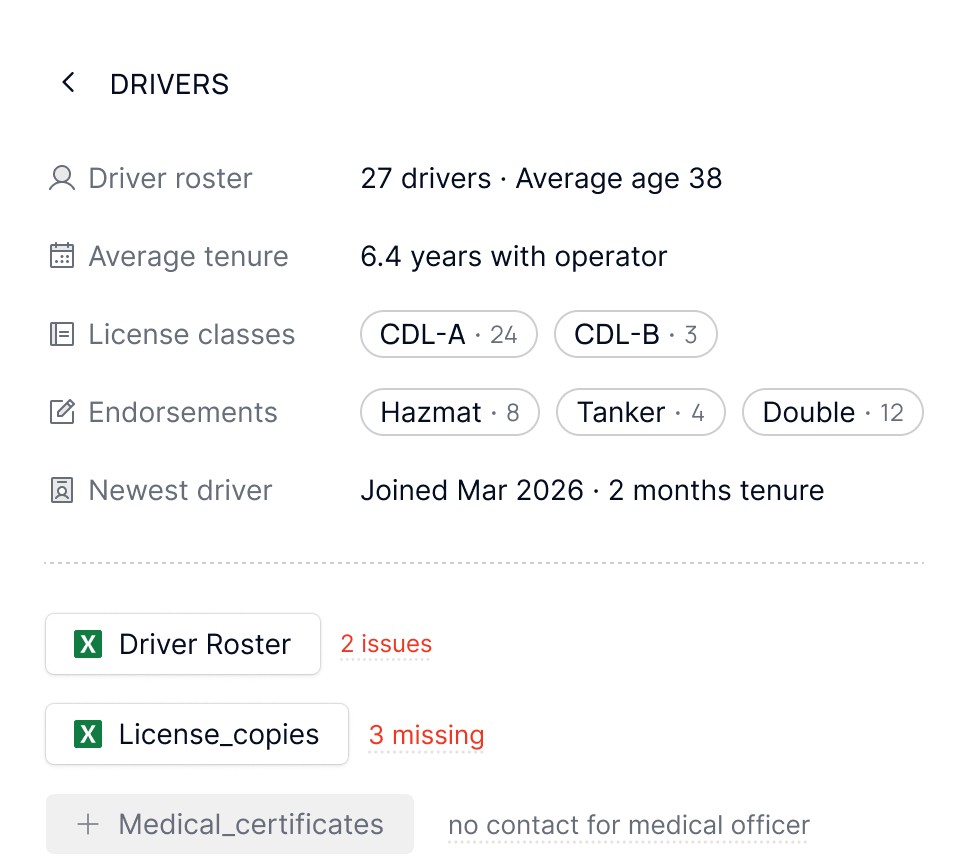
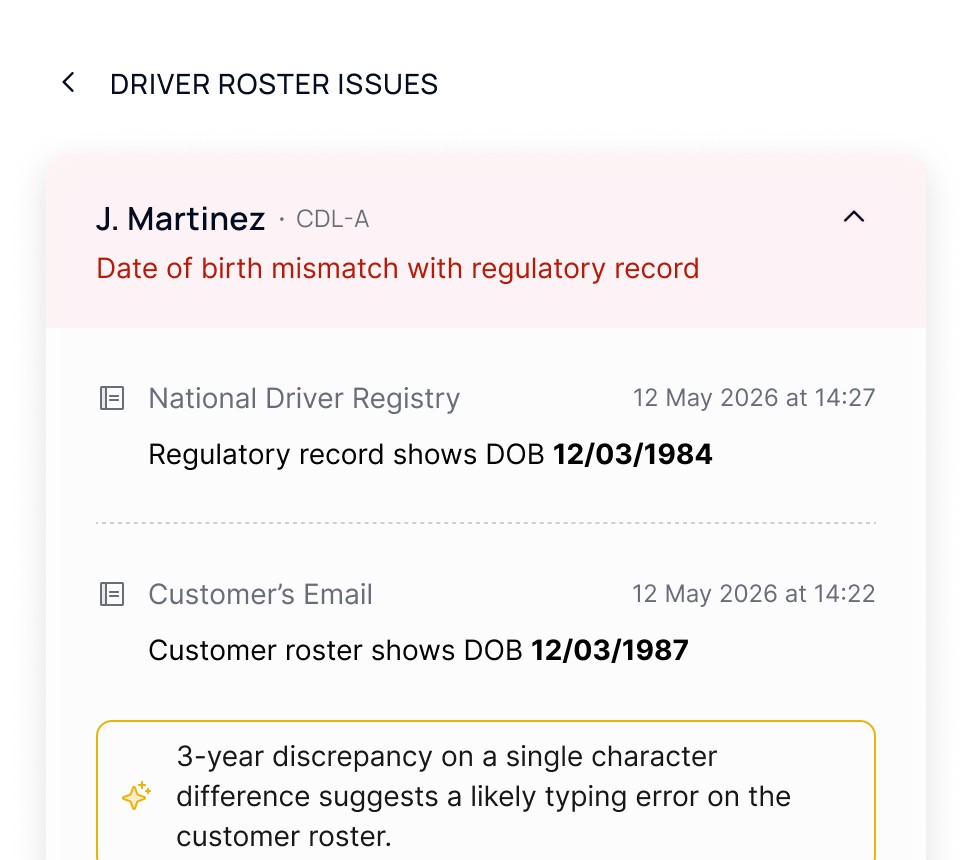
A broker reading a driver roster is not just counting headcount. They are reading signals. Average tenure tells them how stable the fleet is, a high tenure suggests an operator who retains drivers, which carriers read as lower risk. Average age tells them something about continuity and the health profile of the fleet going forward. Endorsement types tell them which carriers the fleet is even eligible for. These are not data points the broker has to derive themselves. The AI surfaces them as a read, in the same terms a broker would use to pitch the account to a carrier.
But the more important job is verification. The broker provided data. The AI cross checks it against external sources; regulatory records, licensing databases, telematics providers. Where the data matches, it is confirmed. Where it conflicts, the AI surfaces both values side by side, with the source and timestamp of each. The broker does not see a flag. They see exactly where the discrepancy is, where each value came from, and what resolving it would require.
This pattern holds across every section of the submission. The AI is not checking boxes. It is doing the same preparatory work a broker would do before putting a submission in front of an underwriter; section by section, source by source. Surfacing only what needs a human decision.
FROM ASSESSMENT TO ACTION
Once the broker knows exactly what is missing and why, the next move is straightforward. They need to go back to the customer and ask for the pending items. In a traditional brokerage this means the broker reads through the submission, compiles the gaps manually, writes the email, and sends it. That alone can take the better part of an hour.
The AI has already done that work. It knows what is missing, what is conflicting, and in some cases why it could not fetch a document automatically. The broker reviews the draft, adjusts the tone if needed, and sends. The first outbound message is drafted for the broker to review, not written from scratch.
But the bigger shift happens over time.
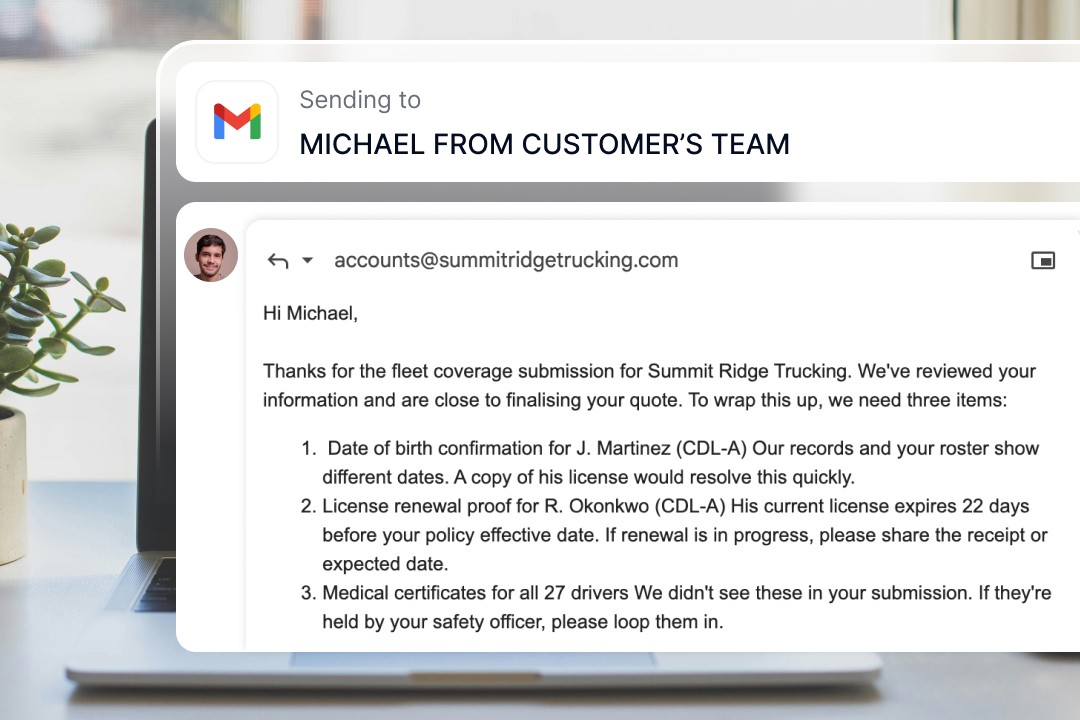
A submission does not move from incomplete to ready in a single exchange. The customer responds. New documents arrive. Some gaps close. New ones surface. This cycle repeats, sometimes three or four times before a submission is ready to go to an underwriter.
Each time the customer responds, the AI re-reviews the full submission, cross checks the new documents against what it already holds, and surfaces only what has changed. The broker picks up exactly where the last exchange left off, no re-reading, no re-compiling, just the new information that needs a decision. The more cycles a submission goes through, the more time the AI saves.
The AI does not replace the broker. It clears the path for them to do the work only they can do.
WHAT THIS TEACHES ABOUT AI PRODUCTS
This is the pattern that compounds across a broker's book. Every submission goes through the same intake cycle; incomplete data, back and forth with the customer, gradual resolution. The AI handles that cycle. It shadows the repetitive layer so the broker does not have to. What gets freed up is not just time. It is attention, for the accounts that need a relationship, for the customers that need chasing, for the judgement calls that no intake tool can make.