Nirvana Insurance · 2025–2026 · 6 minute read
AI routing without transparency creates rejection, not adoption
How an AI routing surface lets a commercial trucking underwriter handle three states: auto quote, auto decline, and needs review; without losing the human in the loop.
MY ROLE
I was the designer on this project, embedded with product, underwriting, and engineering over three months. The brief started with a single question: how do we use technology to put the underwriter's attention where it matters most?
The routing logic was owned by the underwriting team. My job was to make that logic legible, translating their decisioning framework into a surface that underwriters could trust, verify, and override. I took it from early concepts through multiple rounds of feedback with underwriters, until the behaviour felt right to the people using it every day.

THE PROBLEM
Every commercial trucking submission lands in an underwriter's queue in one of three states. Some are clean enough to quote in two minutes. Some are obviously outside appetite. Most sit in the middle, requiring real judgement.
In a traditional carrier, all three types arrive looking the same: a PDF, a spreadsheet, an email. The underwriter triages manually. The easy work crowds out the hard work, and both end up done worse than they could be.
The routing data has always existed. The interface to make it visible hadn't. That was the design problem.
WHAT CHANGED FOR THE UNDERWRITERS, BY NUMBERS
THE QUEUE
The underwriter's morning starts here. Every new submission has been pre-classified by the AI into one of these states.
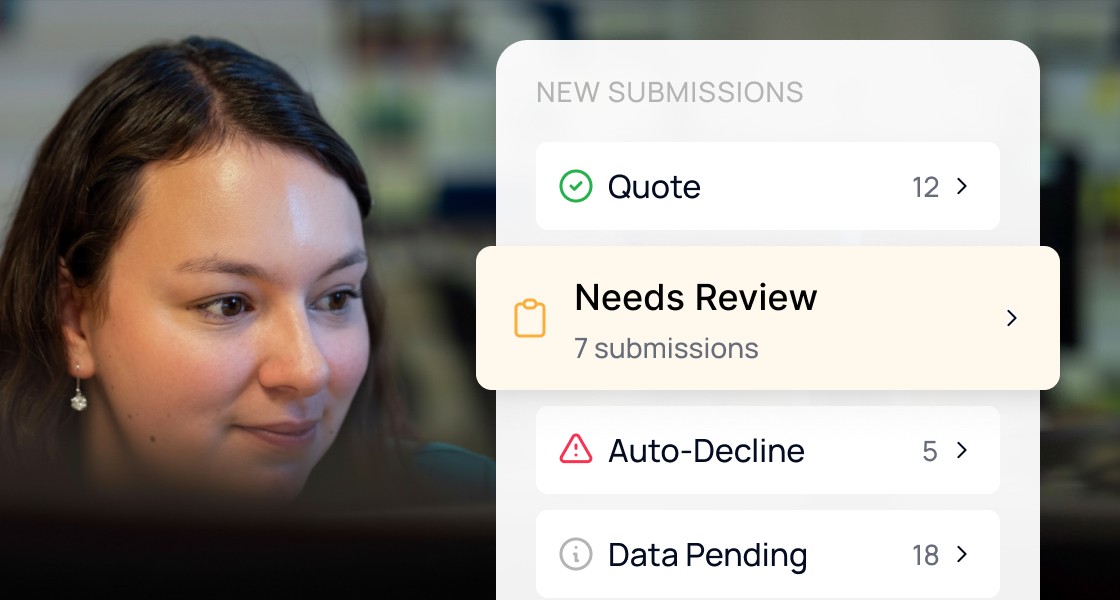
Data Pending: The AI is still gathering. The underwriter doesn't see these yet.
Quote: Clean accounts, all guidelines passed, ready to bind with one review.
Needs Review: The AI couldn't reach a confident recommendation. The underwriter is the tiebreaker.
Auto-Decline: Outside appetite. The AI has drafted the broker notification.
Each state is a routing decision the AI has already made, with full reasoning attached. The underwriter can verify, override, or accept. The classification work has already been done. That's where the 50% reduction in review burden comes from.
STATE 01 · QUOTE
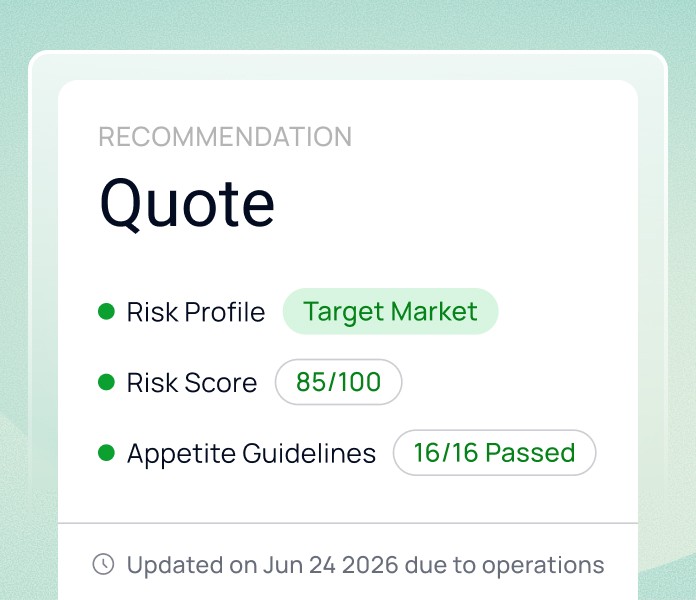
When the AI recommends Quote, three things become visible at once.
The risk profile, where this account sits relative to the full submission pool.
The risk score, how favourable the account looks overall.
The appetite guidelines, how completely the AI was able to analyse the available information.
Everything they would have assembled manually is already on the surface, summarised and traceable. The recommendation is not "trust me, quote this." It is "here are the 16 guidelines, here is the score, here is the data behind each one."
Every guideline carries its source. This matters because the type of source determines the confidence the underwriter can place in it. Data fetched directly from a regulatory record carries different weight than data entered by the broker, which could carry input errors. Data pulled from a telematics provider carries different failure modes than data cross checked against FMCSA endorsements. An underwriter who knows the source knows what kind of scrutiny to apply. They are not reading a number. They are reading a number with a history.
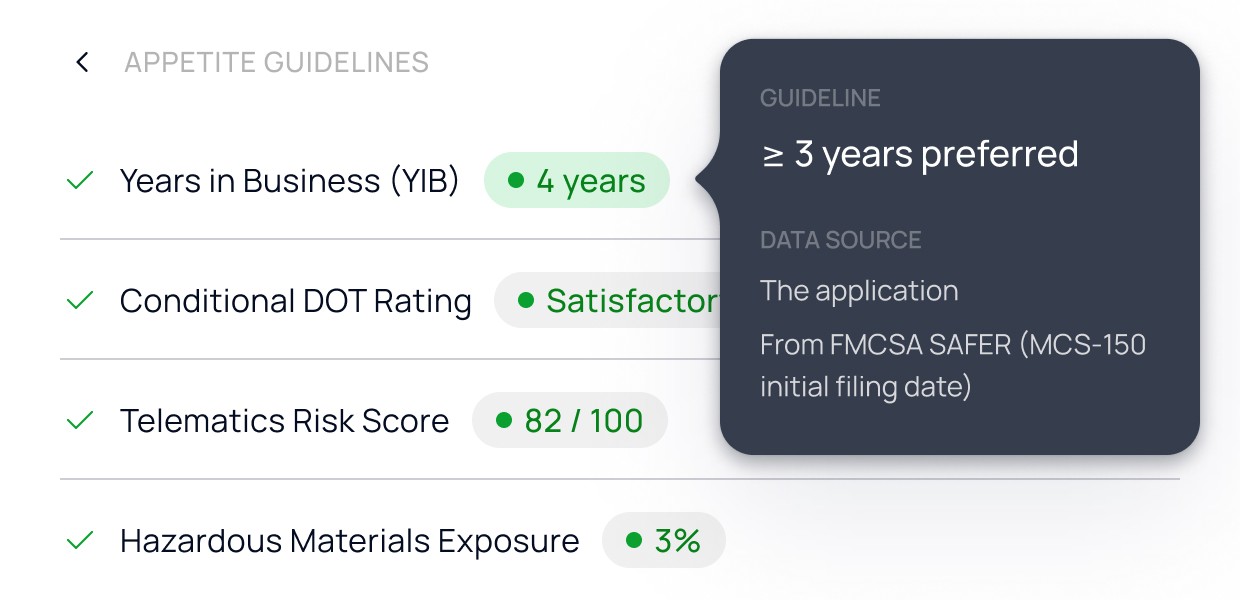
The underwriter never has to ask where the AI got a value. The answer is built into the surface, there when they need it, out of the way when they don't.
STATE 02 · AUTO-DECLINE
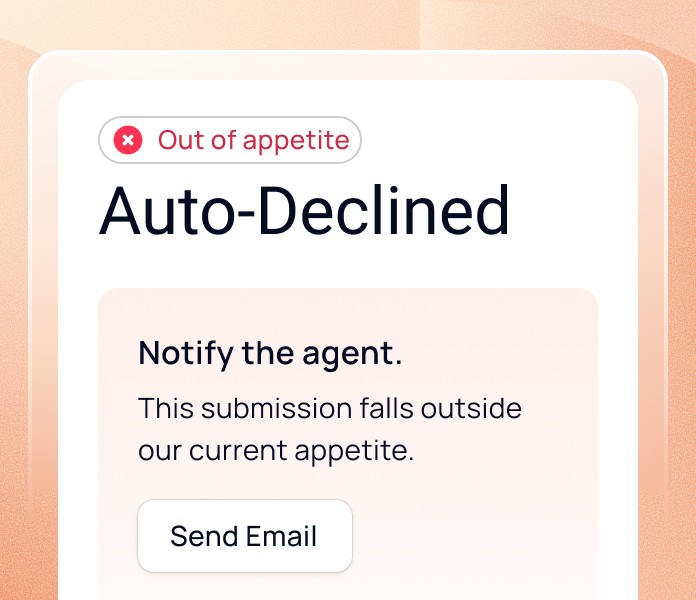
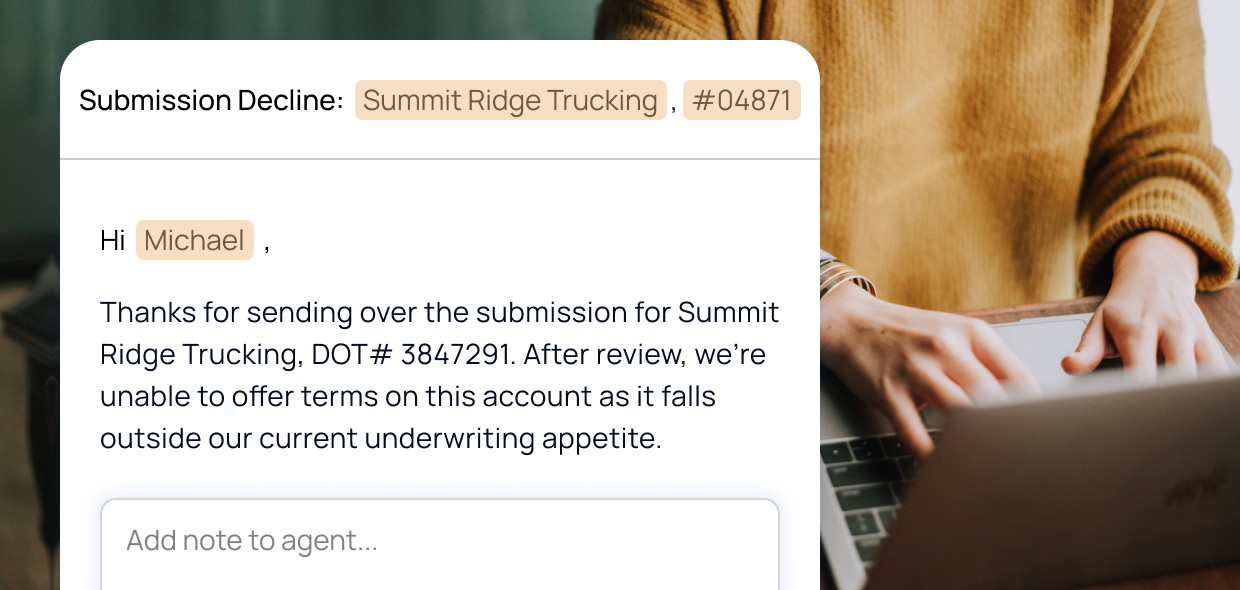
When the AI recommends Auto Decline, the work shifts from whether to write the risk to how to communicate the decision.
The recommendation panel shows Out of Appetite. The system has already drafted the broker notification email, named the broker, and referenced the specific submission ID. The underwriter doesn't write the rejection from scratch, they review, edit, and send.
A traditional decline takes 15 to 20 minutes of underwriter time. The AI version takes 90 seconds, most of which is the underwriter reading what was drafted on their behalf.
STATE 03 · NEEDS REVIEW
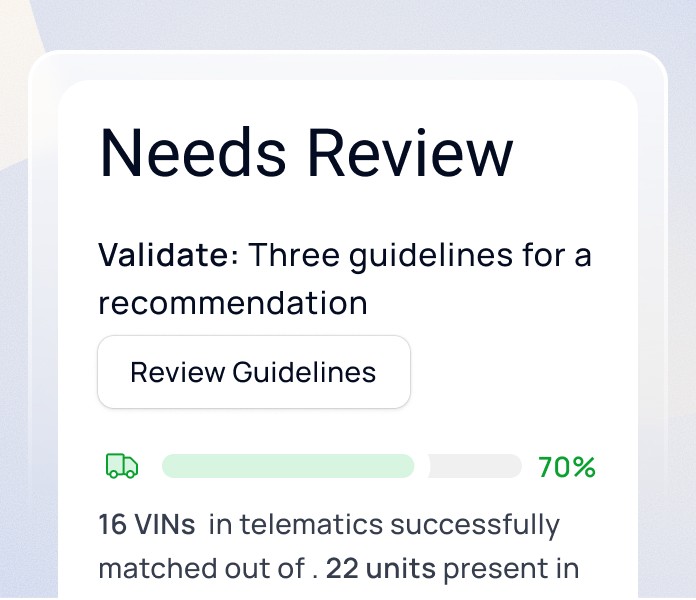
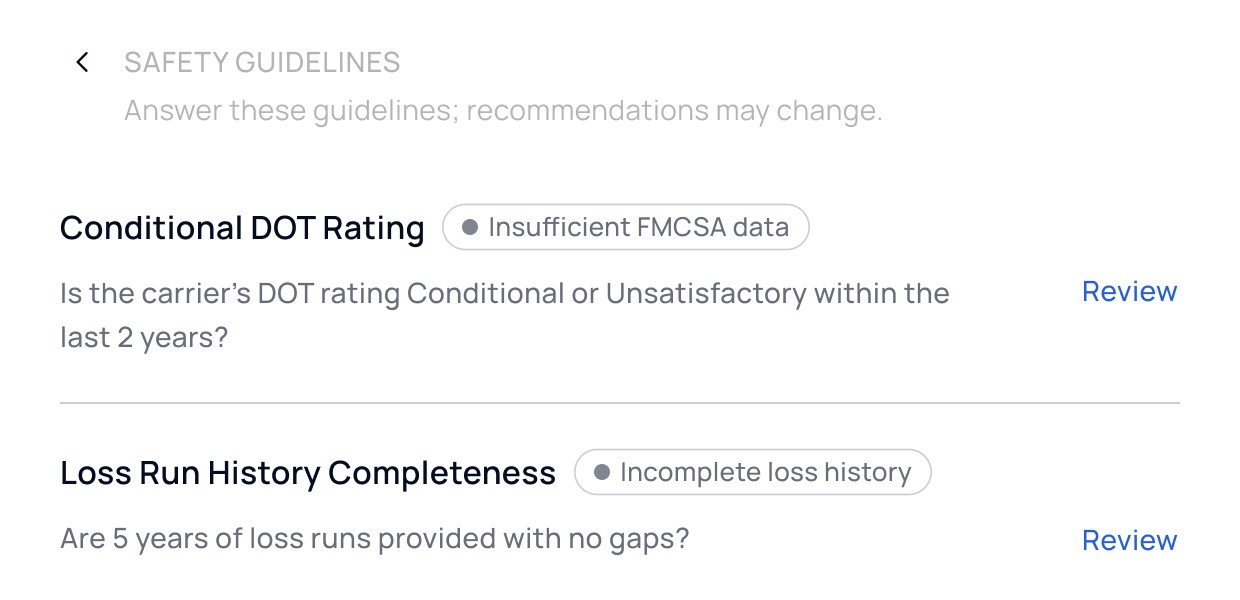
When the AI can't reach a confident recommendation, the surface has to do two things at once. Tell the underwriter exactly what's unresolved. And give them the smallest possible piece of work required to resolve it.
The Needs Review panel surfaces the three guidelines the AI couldn't validate. The underwriter clicks Review, answers the specific question, and the recommendation regenerates. 70% of the submission has already been validated. The AI surfaces exactly what 30% it still needs the underwriter for. Their time is spent on the unresolved part, not the whole file.
WHAT I GOT WRONG
The biggest design contention wasn't whether to show the source behind each AI recommendation. It was how much real estate to give it.
In the first version, I treated the source as a tooltip. Hover to see where the AI got each value. The reasoning was that most underwriters would not drill in for most decisions, so the surface should stay clean for the ones who do not.
We were wrong.
Underwriters were drilling in constantly, and the tooltip made it feel like something the system was hiding. The redesign treated source attribution as a flexible primary or secondary surface depending on the recommendation's risk profile. Auto Decline recommendations showed the source in the foreground. Quote recommendations kept it a step back. The underwriter could pull either into focus depending on what they were investigating.
WHAT THIS TEACHES ABOUT AI PRODUCTS
The interface isn't doing dramatic things. A queue with three states. A scorecard with sixteen guidelines. A tooltip showing a data source. Nothing visually exciting.
The work is in the calibration. How does the AI decide which state a submission belongs in? How visible should the source be? How easy is it to override? What gets shown when the AI isn't confident?
Designing this surface was mostly about understanding what the underwriter brings that the AI does not. The AI is good at gathering, fast at checking, consistent across volume. The underwriter is good at exceptions, fast at judgement, confident in context. The interface has to make the boundary between those two strengths clear, adjustable, and honest.
Getting it wrong does not produce a slow product. It produces a bound policy the underwriter should not have signed off on, a decline the system should not have sent, or a needs review case that bounces between states because the surface never made clear what was blocking it.
The interface is simple. The consequences are not.